Code The City is a civic hacking initiative focused on using tech and (open) data for civic good. We use hack weekends, open data, workshops, and idea generation tools. We run Data Meetups, the Aberdeen Python User Group and the annual Scottish Open Data Unconference
To complement our current skill base, and support our ambitious plans for 2020, we are looking to recruit two additional trustees to join Code The City.
About Code the City
Code The City is an Aberdeen based charity. We believe that putting technology, design, and data skills in the hands of the community can improve the quality of life for the individual, and the community as a whole. Introducing people with challenges to new skills, and introducing people with skills to new challenges is at the heart of what we do.
Our mission is to help people learn, use, and apply technology and data skills for civic good.
We are a small, focused charity primarily delivering public events and training programs. 2019 was a pivotal year for Code the City, moving from a quarterly event program to a near weekly program. We added new events and started serving new local audiences – including local young coders. We also extended the reach of our important open data work to a national level.
What will you be doing?
Trustees do not have to take on any specific responsibilities. Each year, we elect a Chair and Treasurer. We also ask any willing Trustees to do some specific jobs, these change over time to meet current needs.
At present, we have 3 Trustees – we aim for no more than 5 during 2020.
We have a detailed plan for the year ahead. We meet quarterly for an evening board meeting (2 – 3 hours), and monthly for a breakfast meeting (~1hour, optional). Additionally it would be natural, although not essential, to attend some of our growing programme of events in some capacity.
What are we looking for?
We would really welcome people with enthusiasm for the community benefits that technology and data can bring. We are particularly keen to strengthen our collective background in charity operation, fundraising, and organisational collaboration.
Technical coding and data skills are far from essential, although some enthusiasm for the transformative power of digital and data would be useful.
What difference will you make?
We welcome applications from individuals who are able to use their knowledge and experience to help lead this rapidly developing organisation. Without Trustees the charity is unable to function – we need and depend on the generosity of those with relevant experiences and skills to join our team.
The potential impact of projects born at our events is significant. Our aim is to improve the lives of people in the city. You can help us deliver this work.
What’s in it for the volunteer?
The role, although unpaid, is a very fulfilling one which provides an opportunity to make a difference to individuals engaged in our programs, and to the wider community. It provides an opportunity to collectively share experience and expertise with others in a welcoming environment.
Our Trustees are valued and respected team members – come and join us!
How to apply
The person dealing with recruitment is Steve Milne, please make contact with Steve at steve@codethecity.org.
Earlier this year Code The City held an Editathon with Wikimedia UK. The subject was the history of Aberdeen Cinemas. We ended up with 16 people all working together to create new articles, update existing ones, capture new images for Wiki Commons, and generate or enhance WikiData items. This was a follow up to previous sessions that Dr Sara Thomas of WikiMedia UK led for us in the city, mainly for information professionals.
This has led to significant interest from cultural bodies in the city in using the suite of WikiMedia platforms and tools to improve access to their collections in Aberdeen. We expect to do quite a bit more of this with them in 2020.
Two weeks ago I attended a Train the Trainer 3-day workshop in Glasgow for Wikimedia UK to become a trainer for them in Scotland. That will see me training professionals and volunteers in how to use Wikipedia, Wiki Commons and Wikidata in particular.
In this blog post I explain why you might want to use some of the fancy features of WikiData query service, show you how to do that, using on my adaptation of others’ shared examples, and encourage you to experiment for yourself.
Wikidata
Wikidata uses a Linked Open Data format to store data. While I have added quite a number of items to Wikidata I’ve not had a chance to really study how to use SPARQL (the query language behind the scenes) to to execute queries against the data. This is done in the Wikidata Query service. This is a key skill to using some of the more advanced features. Without the means to extract data there is little point in stuffing data into it. In fact WikiData allows us to do some very fancy things with the data which we retrieve.
So, I decided this week to start working on that. This describes the first steps I have been doing. It should also provide a simple introduction to any else wanting to dip their toe in the SPARQL waters.
Where to start?
This 16-minute tutorial on Youtube is a great place to begin; it is where I started. It describes how to create a simple query and build it up to something more powerful. I copied what it did then adapted that to build a query that I wanted. I suggest that you watch it first to understand what each line of SPARQL is doing.
Here are the steps, mainly frown from and adapted from that tutorial.
Find all female graduates of Aberdeen University
In the query above we use the Educated at statement (P69) and the identifier for Aberdeen University (Q270532 ) in combination with the Sex or gender statement (P21) with the Female identifier (Q6581072).
You can run this for yourself here using the white-on-blue arrow. I’ve used one of the great things you can do with Wikidata which is to share this query using the link symbol on the left of the page just above the arrow:
Save a Wikidata query
Changing the parameters of the query means that we can check males (Q6581097) against females (Q6581072). Or you can compare different universities. To do this go to the Wikidata homepage and search for the name of the institution. The query will return a page with the Q code in the title. Thus we can compare various universities by amending the Q code in the query above: University ofAberdeen (Q270532) with University of Glasgow (Q192775) or Edinburgh University (Q160302).
Running these queries we can see that the number of both male and female graduates with entries on WikiData of Aberdeen University is significantly smaller than from either Glasgow or Edinburgh, and we can see that the proportion of females of all graduates for each university is smallest for Aberdeen.
University
Male Grads
Female Grads
% Female
Aberdeen
944
125
11.7
Edinburgh
3804
571
13.1
Glasgow
1562
291
15.7
The results of these queries should themselves cause us to reflect on the relatively smaller number of results of either gender from Aberdeen compared to the other universities; and also the smaller proportion of women. It suggests that there is some work to do to ensure that we get better representation of both genders in Wikidata.
Enhancing our query
Now that we have a basic query we can retrieve additional bits of data for the subjects of the query including place of birth, date of birth and images.
These are represented by P19 (birth place), P560 (date of birth) and P18 (image). As we see in the example below, when we query these we follow them with a name we assign to the item returned (e.g. ?person wdt:P19 ?birthPlace ) and we add the name we give it, in this case ?birthPlace to the Select statement on the first line of the query, ensuring that it will feature in the data returned in the table or other format output.
enhanced wikidata query
You will note that the above example now uses the ?birthPlace to create a new query to get the co-ordinates (P625) of that place which we assign to coordinates:
> ?birthPlace wdt:P625 ?coordinates
and we include coordinates in the first line of things we will display.
Advantages of extra data elements
By having birthplace coordinates we can plot the results in a map which is easily done using the tools built into the wikidata query service.
Run the query (white arrow on blue on the left menu) and observe the table that was returned. You can see that the first line of the Select statement formed the columns of the table.
Table of wikidata query results
Note that instead of 125 results as we had in the simple query, we only get 20 results. My understanding of this is that we are specifying records which must have a place of birth, an image etc. Where these do not exist then they records for that person are not returned. This in itself shows that there is a piece of work to do to identify where records in the batch of 125 lack these elements and fix them.
In fact you could say that there is a whole cycle of adding data, querying it, spotting anomalies, fixing those and re-querying which leads to substantial enrichment of the data.
Map results
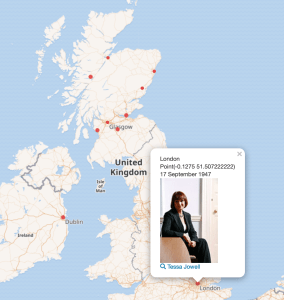
Now click on the dropdown by the eye symbol, on the left immediately above the results, and choose the map option. The tool will generate a map with a pin in the location of each place of birth. You can pan and zoom to the UK and click on each pin. Try it. To get back to the query, click on the arrow, top-right.
Wikidata map view with clicked point
A timeline
Now click on the eye symbol to show other options, and choose Timeline.
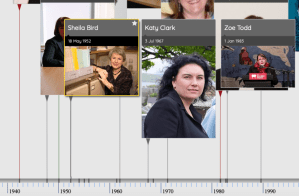
As we can see below, the Wikidata query service will construct a rudimentary timeline with relatively little effort. This is one of its great features. So far we have the same 20 complete records – and the cards or tiles are titled by the place of birth but we can change that.
Wikidata timeline
Enhancing the timeline on Histropedia
To improve on our timeline we can construct a better query using the Wikidata Query Service then paste it into the Histropedia service to run it. Our first version which makes small improvements on our previous timeline produces the results below. This labels by the person’s name, and colour codes the individual records by place of birth label. To see the code, click the gear wheel at the top right of the screen. Note we still only retrieve 20 results.
A first query on Histropedia
We can substantially enhance this query as we have done on the following version. This makes certain items optional, gets the country of birth and colour-codes by that, and ranks the records by prominence (with the most prominent at the front). If I understand it correctly by using optional elements it also retrieves 76 records, much more than previously.
enhanced Histropedia timeline
I would encourage you to watch the tutorial video at the start of this post, then try to hack some of the queries to which I provided links. For example how many female graduates of the Robert Gordon University would each query generate? How would you find the Q code of that institution? Have fun with it!
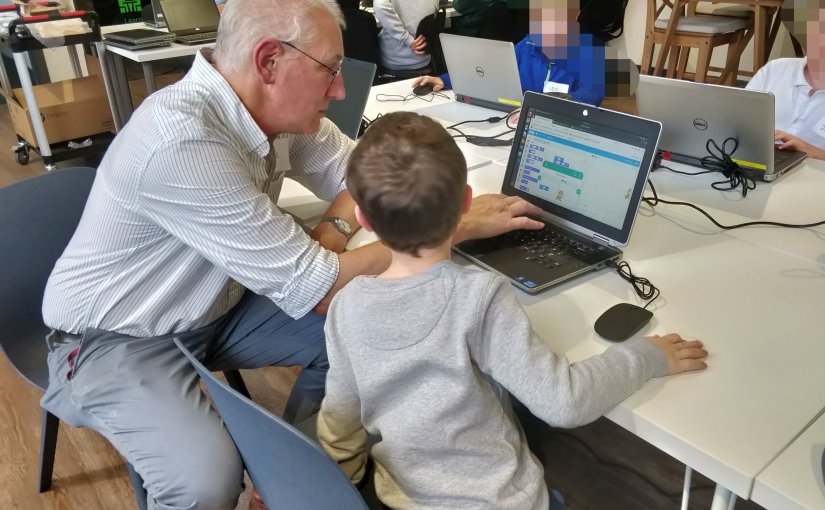
At CTC we work with ONE Codebase to deliver Young City Coders classes. These are after school activities to encourage young people to get into coding by trying Scratch, Python and other languages in a Coder Dojo like environment.
Inoapps generously gave us some funding to cover costs and donated old laptops (as did the James Hutton Institute) which we cleaned up and recycled into machines they could use.
All of which is great – and we have 20-25 kids each session starting to get into these coding languages.
The Challenge
But there is an issue – the bulk of our kids are overwhelmingly from west-end schools. And we have an aim to help kids in regeneration areas where opportunities are generally fewer.
So, that means identifying Aberdeen schools that fall in the regeneration areas and contacting the head teacher and having a discussion about what help they would like to see us provide. Simple?
No.
Search for regeneration areas
Starting with the basics – what are the regeneration areas of Aberdeen? According to Google, the Aberdeen City Council website doesn’t tell us. Certainly not in the top five pages of results (and yes, I did go down that far).
Google’s top answer is from the Evening Express article which says that there are five regeneration areas: Middlefield, Woodside, Tillydrone, Torry and Seaton. From what I have heard that sounds like it might be about right – but surely there is an official source of this.
Further searching turns up a page from Pinacl Solutions who won a contract from ACC to provide wifi in the Northern regeneration areas of “Northfield, Middlefield, Woodside and Tillydrone.” Which raises the question of whether Northfield is or isn’t a sixth regeneration area.
The Citizens Advice Bureau Aberdeen has an article on support services for regeneration areas of “Cummings Park, Middlefield, Northfield, Seaton, Tillydrone, Torry, Woodside and Powis.” That adds two more to our list.
Other sites report there being an “Aberdeen City Centre regeneration area.” Is that a ninth?
Having a definitive and authoritative page from ACC would help. Going straight to their site and using the site’s own search function should help. I search for “regeneration areas” and then just “regeneration.”
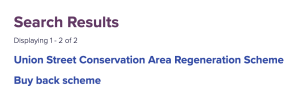
ACC results for regeneration areas
I get two results: “Union Street Conservation Area Regeneration Scheme” and “Buy Back Scheme”. The latter page has not a single mentionof regeneration despite the site throwing up a positive result. The former appears to be all about the built environment. So it is probably not a ninth one in the sense that the others are. Who knows?
So what are the regeneration areas – and how can I find which schools fall within them?
Community Planning Aberdeen
Someone suggested that I try the Community Planning Aberdeen site’. Its not having a site search wasn’t very helpful but using Google to restrict only results from that domain threw up a mass of PDFs.
After wading through half a dozen of these I could find no list or definition of the regeneration areas of the city are. Amending the query to a specific “five regeneration areas” or “eight….” didn’t work.
Trying “seven regeneration areas” did return this document with a line: “SHMU supports residents in the seven regeneration areas of the city.” So, if that is correct then it appears there are seven. What they are – and which of the eight (or nine) we’ve found so far is not included – is still unknown.
Wards, neighbourhoods, districts, areas, school catchment areas
And – do they map onto council wards or are they exact matches for other defined areas – such as neighbourhoods?
It turns out that there are 13 council wards in the city. I had to manually count them from this page. I got there via Google as search the ACC site for Council Wards doesn’t get you there.
I seem to remember there were 37(?) city neighbourhoods identified at one time. To find them I had to know that there were 37 as searching for “aberdeen neighbourhoods’ wasn’t specific enough to return any meaningful list or useful page.
And until we find our what the regeneration areas are, and we can work out which primary and secondary schools fall in those areas, we can’t do very much. Which means that the kids who would benefit from code clubs most don’t get our help.
I though this would be easy!
At the very minimum I could have used a web page with a list of regeneration areas and some jpg maps to show where they are. That’s not exactly hard to provide. And I’d make sure that the SEO was done in a way that it performed well on Google (oh and I’d sort the site’s own search). But that would do at a pinch. Sticking at that would miss so many opportunities, though.
Better would be a set of Shape Files or geojson (ideally presented on the almost empty open data platform) with polygons that I could download and overlay on a background map.
That done I could download a set of school boundaries (they do exist here – yay) and overlay those and workout the intersections between the two. Does the school boundary overlap a regeneration area? Yes? If so, it is on our target list to help.
Incidentally what has happened to the ACC online mapping portal? Not only does it not appear in any search results either, but all of the maps except the council boundary appear to have vanished, and there used to be dozens of them!
Lack of clarity helps no-one
A failure to publish information and data helps no-one. How can anyone know if their child’s school is in a regeneration area. How can a community group know if they are entitled to additional funding.
Without accurate boundary maps – and better still data – how can we match activities to physical areas (be they regeneration areas, wards, neighbourhoods, or catchment areas)?
How can we analyse investment, spending, attainment, street cleanliness, crime, poverty, number of planning applications, house values, RTAs per area if we can’t get the data?
For us this is a problem, but for the kids in the schools this is another opportunity denied.
Just as we highlighted in our previous post on recycling, the lack of open data is not an abstract problem. It deprives people of data and information and stifles opportunities for innovation. Our charity, and our many volunteers at events can do clever stuff with the data – build new services, apps, websites, and act as data intermediaries to help with data literacy.
Until there is a commitment nationally (and at a city level) to open data by default we will continue to highlight this as a failing by government.
——————————-
The header image for this page is for a map of secondary school boundaries from ACC Open Data, on an Open Street Map background.
During the course of Code The City 17: Make Aberdeen Better this weekend we made a startling discovery. It is easier to recycle your old fridge-freezer than to get data and content for re-use from Scottish public sector websites. As a consequence, innovating new solutions to common problems and helping make things easier for citizens is made immeasurably more difficult.
One of the event’s challenges posed was “How do we easily help citizens to find where to recycle item ‘x’ in the most convenient fashion. That was quickly broadened out to ‘dispose of an item” since not everything can be recycled – some might be better reused, and others treated as waste, if it can’t be reused or recycled. With limited kerbside collections, getting rid of domestic items mainly involves taking them somewhere – but where?
With climate change, and the environment on most people’s minds at the moment, and legislative and financial pressures on local authorities to put less to landfill, surely it is in everyone’s interest to make it work as well as it can.
To test how to help people to help themselves by giving advice and guidance, we came up with a list of 12 items to test this on – including a fridge, a phone charger, a glass bottle, and tetra pack carton. On the face of it this should be simple, and probably has been solved already.
The Github Repo
All of Code The City hack weekend projects are based on open data and open source code. We use Github to share that code – and any other digital artefacts created as part of the project. All of this one’s outputs can be found (and shared openly) here.
Initial research
That was where we started: looking to see if the problem has already been solved. There is no point in reinventing the wheel.
We looked for two things – apps for mobile phones, and websites with appropriate guidance.
Aberdeen specific information?
Since we were at an event in Aberdeen we first looked at Aberdeen City Council’s website. What could we find out there?
Not much as it turned out – and certainly not anything useful in an easy-to-use fashion. On the front page there was an icon and group of suggested services for Bins and recycling; none of which were what we were looking for.
ACC Bins and recycling
Typing recycling into the search box (and note we didn’t at this stage know if our hypothetical item could be recycled) returned the first 15 of 33 results. As shown below.
Search results for recycling
The results were a strangely unordered list – neither sorted alphabetically nor by obvious themes. So relevant items could be on page 3 of the results. Who wants to read policies if they are trying to dispose of a sofa? Why are two of (we later discovered) five recycling centres shown but three others not? Why would I as a citizen want to find out about trade waste when I just want to get rid of a dodgy phone charger?
Why is there a link to all recycling points (smaller facilities in supermarket carparks or such like, with limited acceptance of items), but apparently not to all centres which cover much more items? Actually there is a link ‘Find Your Nearest Recycling Centre’ (but not your nearest recycling point which are much more numerous). This takes you a map and tabular list of centres and what they accept. And it is easy to miss the search box between the two. No such facility exists for the recycling points.
Open Data?
Perhaps there is open data on the ACC Data portal that we could re-purpose – allowing us to build our own solution? Sadly not – the portal has had the same five data sets for almost two years, and every one of those has a broken link to the WMSes.
If we were in Dundee we could download and use freely their recycling centre data. But not in Aberdeen.
Dundeee recycling Open Data
Apps to the rescue?
There are some apps and services that do most of what we are trying to do. For example iRecycle – Iphone and Android is a nice app for Android and iOS that would work were it not for US locations only.
We couldn’t find something for Scotland that worked as an App.
Other sources of information?
Since we drew a blank as far as both Aberdeen City Council and any useable apps, we widened our search.
Recycle For Scotland
The website Recycle For Scotland (RFS) is, on the face of it a useful means to identify what to do with a piece of domestic waste. Oddly, there appears not to be any link to it that we could find from any of the ACC recycling pages.
BUT …… it doesn’t work as well as it could and the content, and data behind it have no clear licence to permit reuse.
The Issues with RFS
Searching the site, or navigating by the menus, for Electrical Items results in a page that is headed “This content was archived on 13th August 2018” – hardly inspiring confidence. No alternative page appears to exist and this page is the one turned up in navigation on the site.
Recycle For Scotland Archived content
Searching for what to do with batteries in Aberdeen results in a list of shops at least one of which closed down about 18 months ago. Entering a search means entering your location manually – every time you search! This quickly becomes wearing.
While the air of neglect is strong, the site is at least useful compared to the ACC website. But it doesn’t do what we want. Perhaps we could re-use some of the content? No – there is no clear licence regarding reuse of the website’s content.
The site appears to be a rebadged version of Recycle Now, built for Zero Waste Scotland (ZWS). According to ZWS’s Terms and Conditions on their own site, and deeply ironically, you can’t (re)use any materials from that site.
Zero Waste Scotland – zero re-use
ZWS are publicly funded by the Scottish Government and the European Regional Development Fund – all public money.
Scottish Government Fund ZWS
Public funding should equal open licences
We argue that any website operated by a government agency, or department, or NDPB, should automatically be licensed under the Open Government Licence (OGL). And any data behind that site should be licensed as Open Data.
The Scottish Government’s own website is fully licenced under OGL.
Changing the licensing of Recycle For Scotland website, making its code open source, and making its data open would have many benefits.
its functionality could be improved on by anyone
the data could be repurposed in new applications
errors could be corrected by a larger group than a single company maintaining it.
Where did this leave us?
Having failed to identify an app that worked for Scotland, nor interactive guidance on the ACC website, we tried the patchy and, on the face of it, unreliable RFS site. We’d turned to the data and whether we could construct something useable from open data and repurposed, fixed, content over the weekend – this is a hack event after all.
But in this we were defeated – data is wrapped up in web pages: formatted for human readability, not reuse in new apps.
Websites which were set up to encourage re-use and recycling ironically prohibit that as far as their content and data is concerned, and deliberately stifle innovation.
Public funding from the City Council, the Scottish Government and the European Regional Development Fund is used to fund sites which you have paid but elements of which you cannot reuse yourself.
Finally
At a time of climate crisis, which the Scottish Government has announced is a priority action, it can’t be right that not only is it difficult to find ways to divert domestic items from landfill, but also that these Government-funded websites have deliberate measures in place to stop us innovating in order to make access to reuse and recycle easier!
Hopefully politicians, ministers and councillors will read this (please draw it to their attention) and wake up to the fact that Scotland deserves, and needs, better than this.
Only by having an Open Data by default policy for the whole of the Scottish Public Sector, and an open government licence on all websites can we fix these problems through innovation.
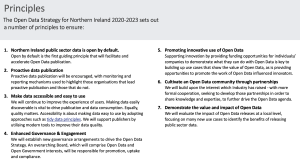
After all if the non-functioning Northern Ireland Assembly can come up with an open data strategy that commits the region to open data by default, why on earth can’t Scotland?
See below:
“Northern Ireland public sector data is open by default. Open by default is the first guiding principle that will facilitate and accelerate Open Data publication.”
NI Open Data principles
[Edit – Added 12-Nov-2019]
Postscript
If you are interested to read more about the poor state of Scottish Open Data you might be interested in this post I wrote in February 2019 which also contains links to other posts on the subject:
At Code The City our objective is help our local community become literate in both technology and data and to use them to full advantage. We help people, organisations and charities to gain the right skills. We are improving what we do at Code The City, and how we do it: changes which are fundamental to making that vision a reality.
Our work up to now
Over the past five years we’ve run 16 Hack Weekends and, in Spring 2018, we started to host monthly data meet-ups. Both things have been very successful but are not the sum total of our ambitions. To deliver those fully we needed a base from which to operate and to grow.
Currently
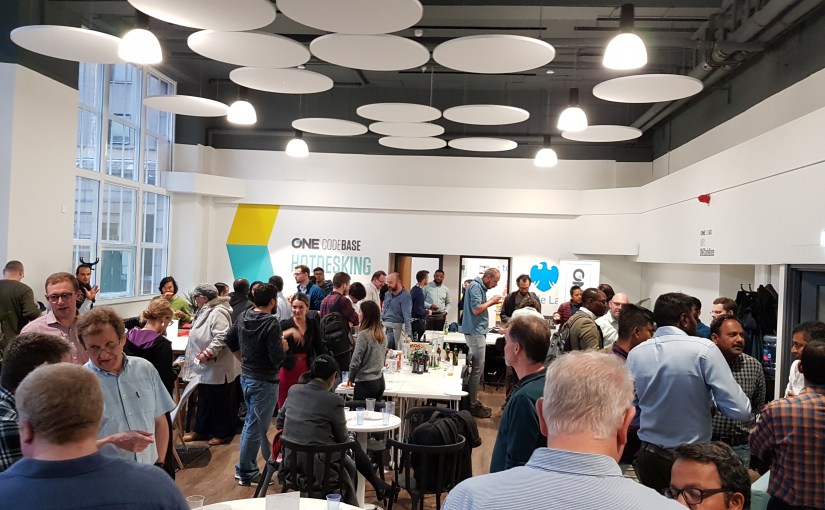
We’re now set up in the ONE Tech Hub, hosted by ONE Codebase. This has cemented our position as part of the local ecosystem. Since moving in six weeks ago we’ve launched the Young City Coders sessions. Our first one, last week attracted 22 keen young people and there is a waiting list for places. We’ll run those twice a month from now on. We’re really grateful for assitance we have received. Inoapps gave us sponsorship to get these sessions started, and both they and the James Hutton Institute donated used laptops.
The immediate future
In another six weeks or so we’ll start a Tech Tribe. That’s the name we’ve given to a programme to get people, and women in particular, into STEM careers and education. Many of them missed the chance first time round. The Data Lab already sponsor our Data Meet-ups and are now sponsoring these sessions, too.
All this educational activity is reliant on volunteer time. Two of our founders, Ian and Bruce, have now become STEM ambassadors. Part of that was getting PVG checks to allow them to work with children and vulnerable adults. We have a handful of others who are going to go through the same process. But, we want to be resilient, and scale up and so we need more people. If you would like to volunteer and get the appropriate certification, please get in touch.
This week also sees the start of the new Aberdeen Python User Group which kicks off on Wednesday. Python is by many measures the most popular, flexible and growing programming language which is used in data science, astronomy, biology, security, web development…. the list is endless.
Our next Hack Weekend will be in November and will address volunteering and civic engagement. We also hope to run another hack weekend in December just before Christmas.
We are planning a springtime event: the Scottish Open Data Unconference. Details will be announced of these very soon.
A picture takes shape
All this is like a jigsaw puzzle, the picture of which is gradually emerging as we fit the pieces together.
By running coding sessions for youngsters and mums, we are starting to help families better understand the potential of data and technology to transform their lives.
By creating Data and Python Meet-ups we are creating networking opportunities. These raise awareness of the good work that is going on in academia and industry. It exposes employers to graduate talent. We help people to share their skills, experience and expertise and to self-organise.
By running hack events we are helping charities and public sector organisations to make the most of the opportunities of digital and data to transform. We also help the local tech community of coders and developers and others to give something back to worthy causes.
By leading projects such as Aberdeen Air Quality we put the creation of data into people’s hands. This demonstrates the potential of collective endeavour for a common cause. The data is made available openly for anyone to build any new product or service. And it offers up the potential for schools and universities to use that data to better understand the local environment.
By running a national unconference we bring specialists, experts, and a wider network to the city to mix with local practitioners. This facilitates discussions at local, regional and national levels and between data users, publishers and academics at every level.
Our charity values. Your values?
In addition to all of the above, Ian, our founder CEO, is a non-executive director of the UK-wide Community Interest Company, Democracy Club. Its strapline is “Our vision is of a country with the digital foundations to support everyone’s participation in democratic life.” Now, Ian has joined the steering group of Scotland’s Open Government Network. He is also now on the board of Stirling University-led project, Data Commons.
The commitment of our charity and its founders is to create that better world underpinned by data and digital, from the ground up. That means running events of many kinds. empowering people, giving them the skills and knowledge they need.
You can do your bit too: come to meet-ups; share your work; be part of a network; becoming a STEM ambassador; coach and mentor others, put something back.








 Code The City