
An open letter to Aberdeen City Council

It has been well documented that there is a problem with Aberdeen City Council and their approach to Smart City and Open Data in particular. See these posts, these requests and this github page from a project at CTC11, where we tried to help fix things. Today, a Finnish researcher on Smart Cities posted this on Reddit!  International reputation? What international reputation!

Now it appears that in the relaunch last week of the Aberdeen City Council website, the council has ditched masses of content. This includes the city-wide What’s On which was until recently the most heavily-used part of the council website and which provided an extremely useful community resource.

More digging – well Googling of some popular terms for council website content  and functions – returns nothing but 404 errors. See the list below for some examples.

When, in 2006 when when the site last underwent a major update, the small team took just six months on the transition, beginning to end. No content was lost or broken, and with URL rewriting and redirects they ensured that everything worked on day one.

The council have been working on the current relaunch – on and off as managers were swapped around or were dispensed with – for two years! And the mess of the site, with massive holes in content and functionality,  far outweighs the much-improved look and feel.

So, what is the plan to restore content, much of which is a matter of public record?

We, as tax-payers, have paid for the creation of functionality and information which is of significant public use. So, where has it gone?

For example where is:

Don’t the citizens of Aberdeen deserve better than this?

Maybe someone would care to make an FOI request to the city council – to ask what data the decision-making on transfer of content and functionality was based on, and get a copy of the website stats for the last three months? I think they are fed up of me.

Ian
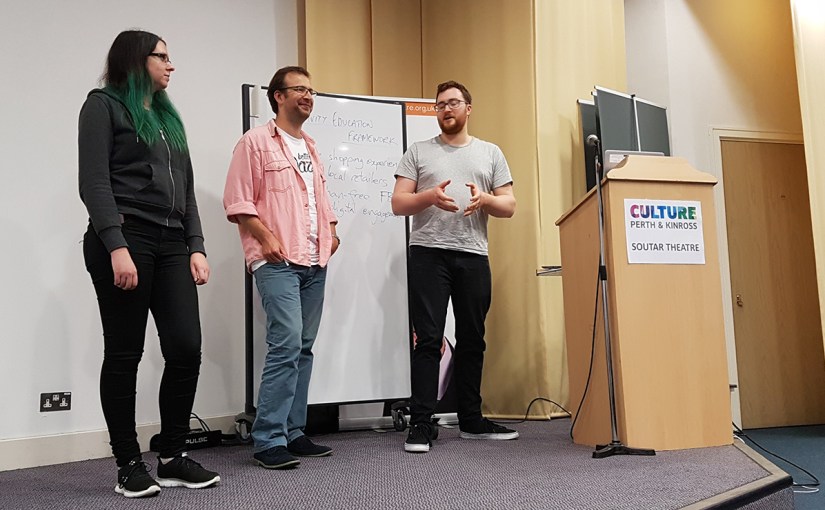
Final presentations at CTC10 – Perth

We had four presentations at the final pitch session at CTC10.

We have uploaded these to Vimeo below (trimming them for time to just the core presentations, and eliminating intros and questions):

Team one: https://vimeo.com/236647324

Team two: https://vimeo.com/236648125

Team three: https://vimeo.com/236649327

Team four: https://vimeo.com/236650501

These brought an enjoyable and productive couple of days to a close.

Well done to all participants involved!.

CTC9 – Near the finish line

Here’s a quick update before the big show-and-tell later on.

Team: ALISS API database

The team has developed a draft version of the website tucked away on a test server. They have established the first functional search using the category ‘social isolation’. It returns a list of service providers in the area that is drawn from the three source databases. This is a big step forward, as we now know how to program a search and are able to deliver visible results on a user interface.

The team is also working on searches based on location by postcode or radius.

One expected challenge is the extraction of information from differently formatted data sources. For example, one source database does not provide contact details in dedicated address fields but in a more general description box.

Team: Soul Cats

This group went back to focusing on the public end users. They came up with various names for this new website that make it easy to find. They played with words from Scots dialect and proper King’s English. All suggestions were googled to see whether they exist already or are buried in amongst a ton of other results. Ideally, we want something unique!

The team suggested to submit a selection of words to a public forum in order to collect opinions or votes.

Team: The Professionals

The Professionals are a spin-off group from the Soul Cats. It’s a rollercoaster with those Cats! They went back to focusing on the value this website for health care professionals. In a structured approach they answered 4 key questions:

  1. Who are key stakeholders?
  2. What are key relationships?
  3. What are key challenges?
  4. What are the gains right now if this project went live?

team-gathering

CTC9 – Sunday Morning

What a beautiful sunny morning for making my way over to CTC9 HQ. It’s a slow start today. Hey, it’s Sunday…

Since we didn’t have a close-out meeting last night, we caught up with everybody’s progress in a kick-off meeting this morning. Make sure to read the update from yesterday afternoon beforehand.

Team: ALISS API

Geek MuffinThe data is flowing! We now have access to all 3 data sources: ALISS, GCD and MILO. MILO too? Yes! As it turns computing student Mikko has been working on hooking up MILO to the project as part of Team ALISS API.

Linking up GCD encountered a stumbling block after the initial success because the WiFi network ended up blocking the website used for our API. By the sounds of it, this is in hand though.

screenshot demoNow that we are connected to all databases, they are being combined by matching titles, identifying duplicates etc. The result will provide access to searchable data from all sources via one URL. James has already launched a temporary live demo page that connects to the databases. The first rough draft is based on story boards James designed with input from the user-focused teams last night. The website is currently at an early stage; so some buttons will work, some won’t. Feel free to rummage around.

There is also a shared file repository on github. It harbours user interface code, the backend REST API and photos from our brain storming sessions.

The next big goal is to develop the visual interface further to make search results visible to the website user. At the moment results appear only in code. The team also suggested that functionalities for location-based search and prioritising search results will require more development.

Sunday team photo

Team: Soul Cats

Teams Stripy Tops and Access All Areas have merged under the new name ‘Soul Cats’ (inspired by a T-shirt). This move made sense because both have been targeting user groups – the professional user (Stripy Tops) and the public (Access All Areas) – and now felt that their paths were converging.

The teams have drawn up more specific suggestions on user requirements based on the needs of different target groups. It’s quite impressive how yesterday’s wide-roaming discussions are now funneling into concrete scenarios and solutions. The obvious conclusion is to make the web interface simple – clear language, natural keywords, self-evident icons, sensible menu structure etc.

There was some discussion around: user cases

  • options for geo-location of service providers relative to user addresses
  • including info on mobility/access issues e.g. stairs
  • including info on parking, public and community transport connections
  • including photos of the service location, exteriors and interiors, so that people easily recognise the place once there

The next steps will involve working closer with our coders and coming up with names for the page, categories etc.